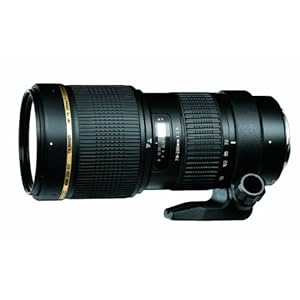
At our site, you will discover Tamron AF 70-200mm f/2.8 Di LD IF Macro Lens for Canon Digital SLR Cameras available at our low prices. Shop now for this item and anything else we have available at our affordable prices.
Product Description
Style: Canon DSLR
From the Manufacturer
This exciting new high-speed, high-performance F/2.8 telephoto zoom for full-frame and APS-C format SLRs delivers outstanding imaging performance in a remarkably convenient package plus best close-focusing ability in its class down to 0.95m (37.4") (1:3.1 at 200mm) throughout the range. Its wide aperture permits the use of faster shutter speeds in any light, and the effective use of shallow depth-of-field to achieve dramatic pictorial effects. The ultimate in reach, speed, and performance for dual SLR formats.
Zoom in with remarkable claritySP AF 70-200mm F/2.8 Di Features While overall dimensions are confined to the absolute minimum, the new SP AF70-200mm F/2.8 zoom lens is packed with features that allow stress-free photography: a versatile MFD of just 37.4" over the entire zoom range; best-in-class maximum macro magnification ratio of 1:3.1 at f=200mm; and an advantageous internal focusing (IF) system. The new tele-zoom lens covers a desirable focal length range of 70mm medium telephoto to 200mm telephoto when mounted on full-size format SLR cameras and a focal length range from 109mm to 310mm ultra telephoto when mounted on a DSLR camera with an APS-C sized imager. Digitally Integrated (DI) Lenses for Top Imaging PerformanceDi (Digitally Integrated Design) is a Tamron designation that applies to lenses that have been optimized for digital capture using advanced multi-coating techniques and optical designs that assure excellent image quality across the entire picture field. Because of these characteristics, Di lenses provide outstanding performance on cameras with full-frame and APS-C format sensors as well as on 35mm film.
Low Dispersion (LD) glass reduces chromatic aberrationLow Dispersion (LD) Glass for Greater Lens Sharpness Low dispersion (LD) glass elements in a lens help reduce chromatic aberration; the tendency of light of different colors to come to different points of focus at the image plane. Chromatic aberration reduces the sharpness of an image, but glass with an extremely lowdispersion index, has less of a tendency to separate (defract) a ray of light into a rainbow of colors. This characteristic allows the lens designer to effectively compensate for chromatic aberration at the center of the field (on axis), a particular problem at long focal lengths (the telephoto end of the zoom range), and for lateral chromatic aberration (towards the edges of the field) that often occurs at short focal lengths (the wide-angle end of the zoom range.) Super Performance (SP) for Discriminating ShootersTamron SP (Super Performance) series is a line of ultra-high-performance lenses designed and manufactured to the exacting specifications demanded by professionals and others who require the highest possible image quality. In creating SP lenses Tamron’s optical designers put their foremost priority on achieving superior performance parameters—they are all designed to a higher standard with little regard for cost constraints. As a result, Tamron lenses bearing the SP designation feature impressive and innovative designs that have established an enviable reputation for excellence among those knowledgeable photographers that demand the very best. Internal Focusing (IF) SystemInternal focusing provides numerous practical benefits to photographers including a non-rotating front filter ring that facilitates the positioning of polarizing and graduated filters, and more predictable handling because the lens length does not change during focusing. Even more important, Tamron’s Internal Focusing (IF) system provides a much closer minimum focusing distance (MFD) throughout its entire focusing range. In addition, IF improves optical performance by minimizing illumination loss at the corners of the image field, and helps to suppress other aberrations that become more troublesome at different focusing positions.
Tamron’s SP AF 70-200mm f/2.8 zoom lens delivers a multi-featured lens with internal focusing while holding the physical lens dimensions to the minimum. With full-size format SLR cameras, this tele-zoom lens covers the full focal length of 70-200mm, and for DSLR cameras with APS-C sized imagers its focal length is equivalent to 109-310mm (with 1.55X approximation). The lens allows a minimum focusing distance of only 37.4” over the entire zoom range and a maximum macro magnification ratio of 1:3.1 at 200mm. Items Included:
- Tamron SP AF70-200mm f/2.8 Di LD (IF) Macro Lens for Canon
- Lens hood
- Case
- 6 year Tamron warranty
Price : $769.00
You Save : $853.95 (53%)

Product Details
- Item Weight: 4.3 pounds
- Shipping Weight: 6 pounds (View shipping rates and policies)
- Shipping: This item is also available for shipping to select countries outside the U.S.
- ASIN: B0012GLHL2
- Item model number: AF001C-700
Price : $769.00
You Save : $853.95 (53%)
Customer Reviews
All of you out there that are reading this review of the Tamron 70-200 are probably in one of two categories. 1) Looking for a fast low light zoom but don't wont to pay the price of the Nikon/Canon 2.8 tele or 2) Your looking for a backup telezoom for your Nikon/Canon. I do wedding, family, sports shoots as a side biz and I'm in category 1. You're probably worried about buying it and it not Auto Focusing fast enough or having some other issues that you've read......because that was a concern of mine. Let me put you at ease.....don't worry, the Tamron 70-200 is fantastic! In fact I was so pleased that I ended up purchasing other Tamron lenses. The 28-75 f/2.8 and also the 17-35 f/2.8-4mm and all 3 have been exceptional to say the least.
AF - Lets get to what everyone is concerned about...Auto Focus. I have two Nikons that I've use this lens on. A D5000 (cropped 1.5x sensor) that I use for quick pics of the kids and vacations (non paying gigs) and a D700 full frame for my professional paying gigs and if the kids have very special events like my daughters kindergarten graduation. I'm really not seeing what everyone is fussing about this lens AF's just as fast as my Nikon DX lens....55-200 VR for example. I use this lens for in and out doors and have never had a problem with it auto focusing. It's like any lens you use.....take a person dressed in black standing in front of a black background and any lens will have a hard time trying to find the focus. Adjust your focal point on the face where the contrast is different and boom it finds it. This is only rare occasions but it does happen sometimes and it also happens with my Nikkors. One thing I do notice is my D700 AF quicker compared to my D5000. It's not by much but it is noticeable, but not an issue. I honestly believe it's due to the difference of the AF systems in the two cameras. D700 is known for its superb AF.
AF Accuracy - Spot on, never a problem. I have my D700 set where it will not release the shutter unless it's in focus and I've never have had a problem with it being fooled or hunting for focus unless it's in a dark closet.
AF loudness - Is the Tamron louder than the Nikkor lenses when Auto focusing? Yes it is. It's not quiet but it's not loud by any means. You have to remember you're the one looking through the viewfinder and of course you're going to hear it. Others won't even notice it. The shutter closing/opening when taking a picture is twice as loud as the Tamron AF system. It's not even an issue. I don't know if I would take it out to the Amazon taking pics of dangerous and exotic animals where my life depended on it......but then again you'd still probably be ok. Remember the shutter is louder than the auto focus.....again it's not even an issue I don't think.
Sharpness - Super sharp at all focal lengths. I've actually have been very pleased with all of my Tamrons and the sharpness it produces. When hand held at 200mm 2.8 it is a tad softer but 95% of that is due to camera shake. I've tested this and have mounted it on a tripod at that setting with sharp as a tack results. Vibration Reduction or Tamrons VC would be a huge plus but it's not totally necessary.
Construction - Very well made, very hefty and durable. I've used Nikons version and it's a fantastic piece of engineering that is weather sealed, built like a tank and is without a doubt more durable. I think this is where the price difference is. The Tamron is not cheap feeling by any means. When you hold it you know its made very well but the Nikon just takes that to another level which is why its $2000 plus US dollars and the fact this it has Vibration Reduction. If you're going to be going through some rugged terrain on a paid photo shoot it would only make sense to purchase the Nikon. Honestly if you took care of the Tamron and kept it clean I'm sure it could make it out fine also but I wouldn't try it.
Overall - Superb sharpness, old school but very effective AF system and AF accuracy, AF noise is not a problem and is really not even loud enough to even mention in this review but I know people have brought it up and are concerned. I'm 100% pleased. Even if I would have paid more I still would have been pleased but that's the beauty of Tamron. Giving you a great professional lens at a great price. Quick story: I was outside under the patio just a couple of days ago taking pics of the massive storm that we had here in Oklahoma using this lens. I would AF on the clouds and press the shutter and to my surprise the shutter would not release. Remember I have it set where it will not take the pic unless it's in perfect focus. After a few times of this I was getting very frustrated and thought to myself........this is what everyone must be talking about when they mean the Tamron has trouble AFing. Few seconds later the shutter goes off taking pics of nothing. I'm thoroughly confused now and then it hit me. Just a day earlier I was taking some self portraits for my online profile and I was using the auto delay 20 second timer and I still had it in that setting.......sigh.....I was quick to blame the Tamron....poor Tamron.
8/19/10 UPDATE:
I've owned this lens going on 3 months now and have used it extensively for indoor events (weddings) and low light evening portrait sessions. I'm still very pleased with the performance. There is one thing I'm a little disappointed in but its not a deal breaker but enough to drop my original 5 star rating to a 4.5.
Sharpness -
At f2.8 and 200mm the sharpness takes a hit some, its actually more of a soft image.....especially in low lighting. If you back off the focal length to 165mm or under it improves. Stopping down to f4 is razor sharp. Its annoying that I can't use f2.8 for razor sharp pics but in reality there's not a lot of lens that are razor sharp when completely stopped down to its maximum, with the exception to some. I'm finding all my Tamrons are this way at f2.8. Of course when asking owners of the $1750 Nikon 24-70 2.8 and $2200 Nikon 70-200 2.8 VR they all say its tack sharp at 2.8.
Auto focusing -
Its still does a great job at AFing but now that I'm getting used to other lenses in my bag (Nikon primes and Tamron Zooms) and then coming back to this 70-200 I am seeing a difference in speed. Its not much and its not a problem but I do feel the difference. Its a tad slower....even slower than my Tamron 28-75 2.8 which in my opinion is still fast. My Tamron 17-35 2.8 does not have internal AF and is a screwdriver cam type where you rely on the camera to do the AFing. Its so fast that it can become violent..it will take your finger off if not careful...ha,ha.
I have owned this lens since November and have taken 1000 plus pics with it. 25% of them are out of focus! I have used it on a 40D, XTI and 50D. I have been shooting middle school sports for 8 years and used a 70-200 f4l, 70-300IS, 85 1.8, and a Tamron 28-75 2.8. All focus much faster and more accurately. All the glowing reviews you read from most users are true, if the image is in focus, The image quality is great. But just like ALL professional review sites point out, this lens mis-focuses much to often for critical once in a lifetime shots. If you cant check your shot and reshoot if needed, do not use this lens. I got this lens to replace the F4L and there is no way I can do that. If the IQ of the 7D at high ISO 3200-6400 are any good I will sell this lens and get that and not need 2.8 for low light any longer.
Here is a quote from the most popular photo website in the world, During testing of this lens.
One problem we encountered with this lens in real-world shooting was a higher than expected proportion of slightly defocused images, especially visible when shooting at F2.8 where the depth of field can be extremely shallow. This was not a systematic 'front-focus' or 'back-focus' problem, but instead an apparently random tendency to miss focus slightly in situations for which we would normally expect a 100% hit rate. This issue persisted across a variety of camera bodies, from the EOS 450D through to the EOS-1D Mark III, so we can only conclude that it is a problem with the lens itself.
Good luck with your purchase.

No comments:
Post a Comment